What you need on the desk
Use paper with three named lines: the baseline (where most letters sit), the midline (the top of a, c, e, i, m, n, o, r, s, u, v, w, x), and the headline (the top of b, d, h, k, l, and the tall part of t). A fourth line under the baseline is for descenders on g, j, p, q, and y. Wide third-grade ruling is easier than college-ruled notebook paper when the hand is new.
The four lines
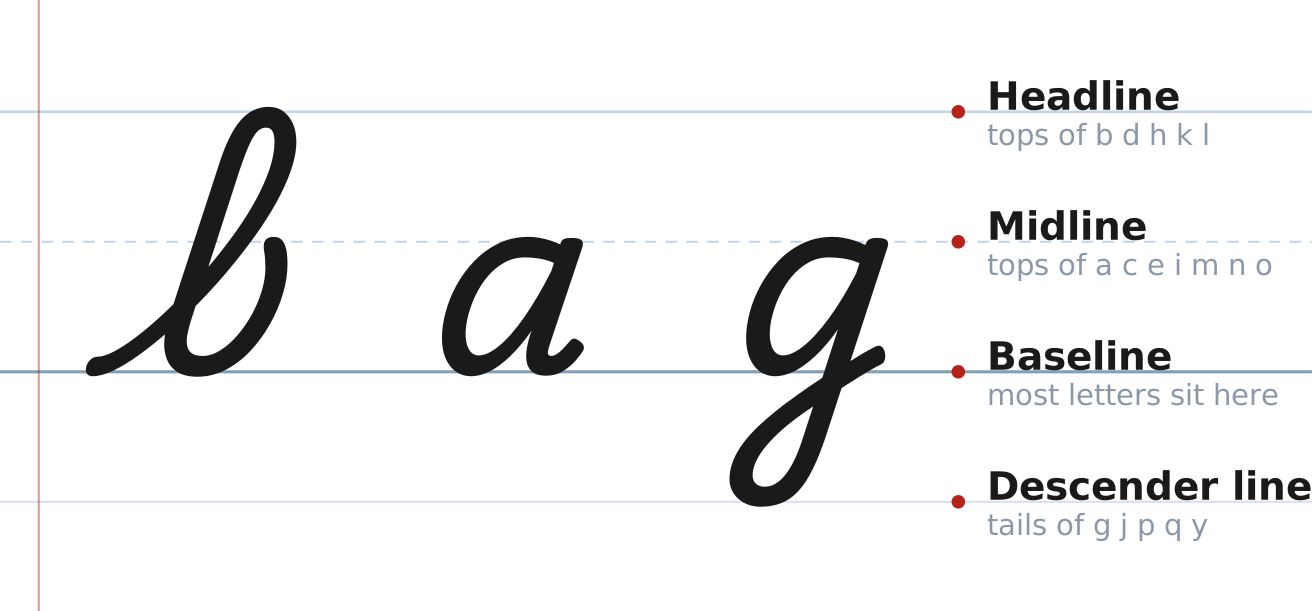
Cursive b, a and g against the four lines.
A sharp pencil beats a fat marker. You need to see whether a loop closed and whether an oval turned the right way. Keep a slant strip or a second sheet under the page if the paper slides. Rightward slant is part of both common US school styles; you teach it with paper tilt, not by twisting the wrist.
If you only need a script line for a bio or a caption, skip the paper and use the cursive generator. That tool copies Unicode. It will not train a hand.
Posture and paper tilt
Sit square, both feet down, forearm resting on the desk so the fingers are not doing the whole line. The pencil sits back in the hand. A death grip makes every oval collapse.
Right-handers rotate the page a little counterclockwise, about twenty to thirty degrees, so a downstroke naturally slants. Many left-handers rotate the page clockwise and keep the wrist below the line instead of hooking over the top. The goal is the same: the downstroke follows the slant, and the wet line is not under the palm.
If the child hooks anyway, fix the paper first. Coaching “relax your fingers” on a page that is still straight to the desk usually fails.
The three strokes you will reuse
Warm-up
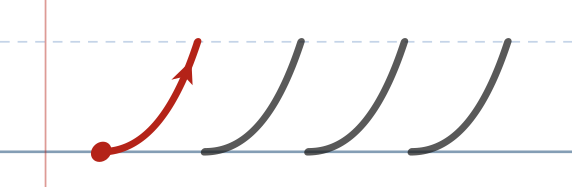
- Undercurve: scoop from the baseline. i, t, e, l start here.
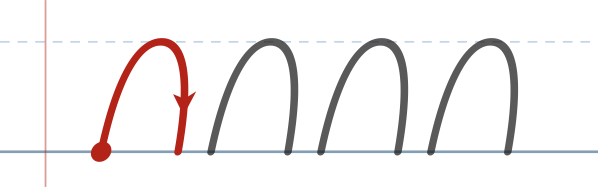
- Overcurve: hump first. n and m. An undercurve here writes u.
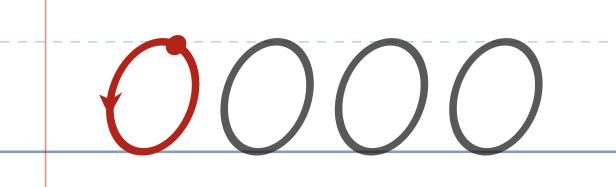
- Oval: counterclockwise. a, c, d, g, o, q. Clockwise is the usual miss.
Almost every lowercase letter is an undercurve, an overcurve, or an oval, sometimes stacked. You can warm up on those three paths before you name a letter.
An undercurve starts on the baseline and climbs in a smooth scoop. It is the first move of i, t, p, u, w, e, l, b, and the rest of that family. Stop at the midline for a one-space letter. Take it to the headline for a tall letter.
An overcurve starts with a hump, the way n and m begin. The pencil moves up and over, then down. If you start n with an undercurve, you wrote u.
An oval is counterclockwise for a, c, d, g, o, and q. Clockwise is the usual kid error; a turns into o, and the bowl of d sits on the wrong side of the stem. Make a row of ovals that all start at the same point on the midline before you add stems.
Size is what splits lookalikes. e and l share a route; l is headline tall. b and f share a route; f punches through the baseline. If you only remember one teaching line, remember that.
Learn letters in groups, not A to Z
A to Z is an index, not a lesson plan. The letter chart is there so you can open one shape. Teach the ones that share a first stroke.
Oval group
Same counterclockwise start. Add a stem or a descender only after the oval is stable.
Loop group
Same undercurve climb. The loop lives at the top. What changes is how far the back travels and whether the exit stays at the midline.
Hump group
Overcurve entries. m is n with one more hump. If the second hump of m is an undercurve, you wrote ni.
High-exit group (some teachers call these tow-truck letters)
These four exit near the midline and the next letter drops its baseline entry. That is why b into e does not climb from the bottom, and why o into r does not get a fresh lead-in.
Capitals wait. They have their own entries, and several of them do not join the next letter at all. When you need a specific shape, open that letter. For a letter people type into search every day, start with cursive S. This page will not repeat twenty-six numbered stroke lists.
Joins come after isolated letters
A join is two exits agreeing. If the first letter is still hunting for its own end, the second letter inherits the mess. Write a line of the same letter, then a two-letter word that uses a join you care about: on, be, it, as, my.
Then write a name. A name is short, it matters to the writer, and it mixes capitals with lowercase. That is enough of a sentence for a first week. Copying a pangram on day two hides which join failed.
Watch the exit height. Zaner-Bloser exits run up toward the midline. If those exits get long, l starts to look like b and u starts to look like w. Shorten the exit before you blame the next letter.
Unicode vs handwriting
The generator turns your typing into Mathematical Script and a few related Unicode styles. Instagram, Google Docs, and a phone notes app will each substitute a different glyph. That is fine for a profile line. It is a poor model for a child to trace, because the joins are not school joins and the slant is whoever designed that font file.
If the job is a tattoo stencil or a place card, treat Unicode as a rough sketch and redraw it. If the job is homework, leave the generator and print a sheet.
School fonts
US classrooms mostly pick Zaner-Bloser or D’Nealian. They agree on slant and on most lowercase bodies. They disagree on lead-ins, on whether p’s stem is a loop or a stick, on where t’s bar sits, and on several capitals. A child tracing the wrong lead-in will fight the model line every day.
The full compare, with a table of the letters that actually change, is on Zaner-Bloser vs D’Nealian. Check that page before you buy a stack of worksheets meant to match a district.
When you are ready to print, use the worksheet builder for a custom word list or a class set of names. Per-letter PDFs stay on the letter pages.
Common questions
How long does it take to learn cursive?
A child who already prints can usually learn the lowercase groups in a few weeks of short daily sessions, then spend longer on joins and capitals. Adults who already write print often get a readable hand in a month if they practice the same groups instead of copying whole sentences from day one. Speed comes after the path is automatic.
Should kids learn print first?
Yes, in most US rooms. Print gives you the baseline, midline, and headline, plus a pencil grip that can last a full line. Cursive then reuses those lines. A few programs start with cursive; if that is your school, match the room instead of adding a second sequence at home.
Why does my child's b look like l?
Lowercase b and l share the same first climb. l exits with a baseline undercurve. b ends in a small bowl at the midline and carries straight across into the next letter at that height. If the child keeps going and drops that exit, b reads as l, and the next letter gets a normal lead-in it should not have.
Where do I get practice sheets?
Print a single letter from its letter page. For a word list or a class set of names, use the worksheet builder. Names stay on your device.